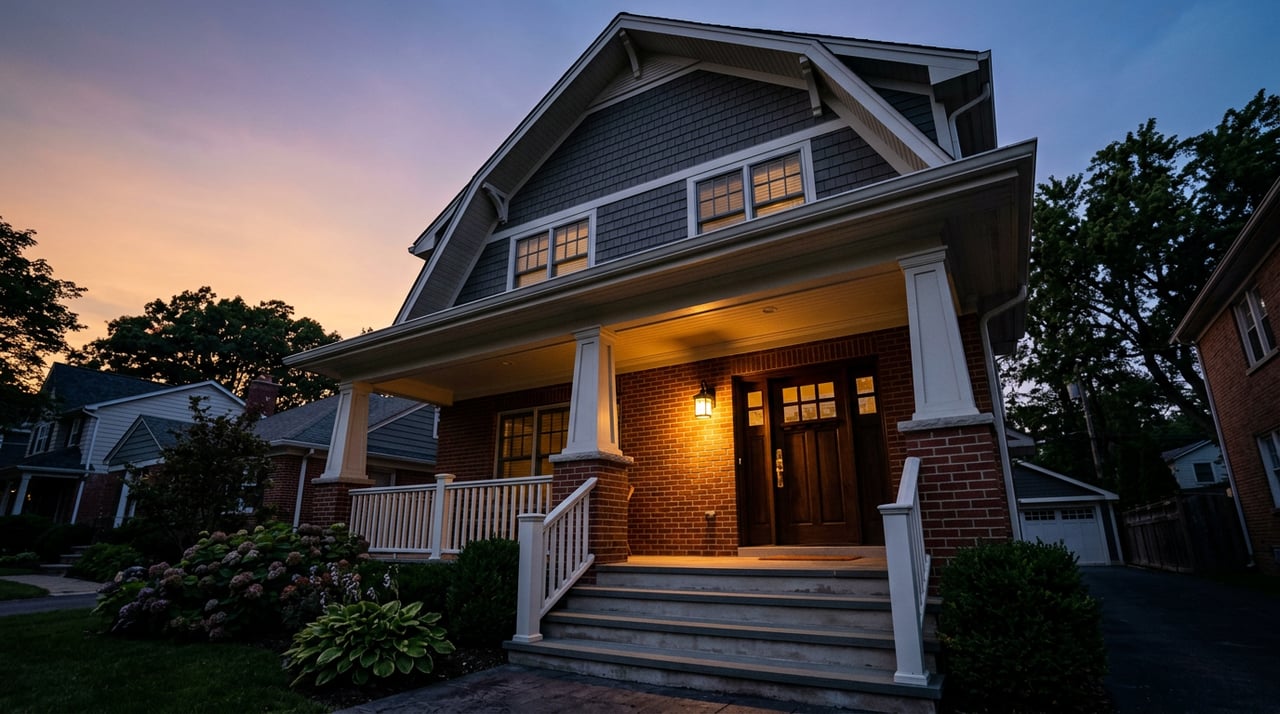
Pull up three different sources for Crescent home prices and you will get three different answers, and none of them are wrong. One shows a median of $192,900 as of April 2026. Another shows the median sale price sitting at $143,000, down 5.6 percent from the year before, with the most recent closed sale dating back to June 2025. A third lists the median asking price at $250,000 as of this past August. Three snapshots, three months, three numbers that do not agree.
The instinct is to pick the freshest one and move on. That instinct is exactly what causes buyers and sellers here to misprice a house by tens of thousands of dollars. The real story is not which number is correct. It is that Crescent's real estate market is small enough that a single boundary line, one most people never think to check, decides which product you are even pricing.
What Three Different Numbers Are Actually Counting
Crescent has roughly 1,450 residents. A town that size does not generate enough monthly closings for a median to behave the way it does in a market like Edmond or Oklahoma City, where thousands of sales smooth out the noise. When the statewide Oklahoma median sat at $264,548 in July 2026, that figure was built on tens of thousands of transactions across a huge, varied inventory, so a handful of unusual sales barely move it.
Crescent doesn't have that cushion. A single acreage sale or a single fixer-upper closing in a given month can swing the town's median by tens of thousands of dollars, because the sample is that thin. That is why one portal's "current" figure was still reporting June 2025 as its most recent closed month while another had already rolled forward to April 2026. It is not that anyone is using stale data on purpose. It is that Crescent sometimes does not have enough transactions in a given window to update the count.
But thin sample size is only half the explanation. The other half is that Crescent is not selling one kind of home. It is selling two, and they come from entirely different regulatory worlds.
The Line That Decides More Than Your Mailing Address
Everything inside Crescent's city limits falls under the town's own building rules. If you want to build or substantially remodel inside city limits, you start at Crescent City Hall on North Grand Street, where permits and inspections are part of the process.
Step outside that boundary, into unincorporated Logan County, and the rules disappear. Logan County's own government page states it plainly:
"There are no planning, zoning, permitting or inspection requirements in the unincorporated areas of Logan County, Oklahoma."
That single sentence is the reason Crescent's listings look so different from each other once you start reading past the price. A three-bedroom house on a small in-town lot is playing by one rulebook. A five-acre tract half a mile outside the same city limit sign is playing by none.
What "No Permit Required" Actually Includes
Once you're outside city limits, the absence of zoning shows up in the details of the listings themselves. A recent set of acreage tracts off Dover Crescent Road, just outside town, offered five-acre lots at $65,000 and ten-acre lots at $130,000, advertised specifically as having no HOA, no covenants, and no minimum square footage, with buyers free to choose their own builder. Prairie Ridge Estates, a subdivision just outside downtown Crescent, markets its 2.5-acre homesites the same way: livestock-friendly, mobile-home friendly, built for buyers who want to bring in a home or build from scratch without a design review board. An 82-acre parcel still zoned Crescent schools but sitting a quarter mile off pavement was marketed on the same open terms.
None of that is available on a standard in-town lot. Inside city limits, a buyer is working with municipal water, defined lot lines, and a permit process. Outside it, a buyer is typically looking at a private well, a septic system, and in some cases a private, unpaved subdivision road maintained by the property owners rather than the town or county.
That does not mean unincorporated land is a free-for-all. Several of the Dover Crescent Road tracts still carry what their listings describe as light deed restrictions, meaning the absence of county zoning does not erase whatever covenants a developer recorded on the plat when the subdivision was created. A buyer who assumes "no zoning" means "no restrictions at all" can be surprised at the title company by a recorded covenant limiting fencing, outbuildings, or livestock density. The plat is worth reading before the offer, not after.
Here is the split in simpler terms:
| Inside Crescent City Limits | Unincorporated Logan County | |
|---|---|---|
| Permits and inspections | Required through Crescent City Hall | None required by the county |
| Water and sewer | Municipal hookup | Private well and septic, typically |
| Roads | Maintained city streets | Often gravel, sometimes private-subdivision maintained |
| Minimum square footage or HOA | Set by town code where applicable | Usually none, unless the subdivision's own recorded plat says otherwise |
| Typical lot size | Standard town lot | Multi-acre tracts, commonly 2.5 to 12+ acres |
Why the Price-Per-Square-Foot Number Moved More Than the Price Itself
Here is where the mismatch gets interesting. In the same reporting window that showed Crescent's median sale price falling 5.6 percent year over year, the price per square foot rose 36.5 percent. A falling median and a rising per-square-foot figure sound contradictory until you remember what a thin market does to averages.
If the handful of homes that closed that month skewed toward smaller, older in-town houses selling below their per-square-foot value, the overall median can drop even while whatever acreage or newer construction did sell commanded a much higher rate per square foot. That is not appreciation. It is a mix shift, a different set of houses closing in a different month, mistaken for a trend. In a market with hundreds of monthly sales, one unusual month barely registers. In Crescent, one unusual month is the whole headline.
What This Means If You're Cross-Shopping Crescent Against Cashion or Piedmont
For a buyer weighing Crescent against other communities north and west of Edmond, the lesson is not to distrust the numbers. It is to ask a more specific question before comparing any two listings by price alone: is this parcel inside the city limits or not?
That single question changes the comparison entirely. A $65,000 five-acre tract off Dover Crescent Road and a $192,900 in-town home are not competing products, even though they both say "Crescent, OK." One comes with a private well, a septic system, and freedom from permitting. The other comes with municipal utilities and a City Hall process. Pricing them against each other on a per-acre or per-square-foot basis without accounting for that difference is how buyers end up either overpaying for permitted convenience or underestimating what a well and septic system will cost to install on raw land.
For sellers, the same logic applies in reverse. A seller listing an in-town home should expect to be compared against other permitted, utility-connected properties, not against acreage. A seller marketing unincorporated land should lean into exactly what Prairie Ridge Estates and the Dover Crescent Road tracts already lean into: no zoning, no HOA, and the freedom to build or bring in a home on your own timeline.
Three Questions Worth Asking Before You Write an Offer
If a listing says "Crescent, OK," does that mean it's inside the city limits? Not necessarily. Plenty of listings use Crescent as the mailing address and school district while sitting well outside the actual incorporated boundary. The city limit line and the mailing address are not the same thing.
Does no zoning mean I can build anything I want on unincorporated land? Not automatically. The county itself imposes no planning or permitting requirements, but a subdivision's recorded plat can still carry its own deed restrictions, as several Dover Crescent Road tracts do. Read the plat before assuming the land is unrestricted.
How do I find out which rules apply before I make an offer? Crescent City Hall on North Grand Street can confirm whether a specific parcel sits inside city limits and what permitting applies. For anything outside that boundary, Logan County's own building permit page confirms there is no county-level review process, but a title search will surface any recorded covenants tied to the specific subdivision.
If you're comparing acreage or in-town listings anywhere between Crescent, Cashion, and Piedmont, Allison Wanjon and her team can walk the parcel-level details with you, city limit lines, well and septic questions, and all, before you write an offer based on a median that may not describe the house you're actually looking at. Begin Your Story at Home.